Improved Results on Higgs Boson Pair Production in the 4b Final State
The CMS Collaboration. CMS-HIG-24-010, Physical Review D (2026), doi:10.1103/w2zp-fckl.
I am one of the main contributors to the boosted-topology analysis. For this publication I was responsible for the calibrations of the trigger and the neural network jet taggers, and I am responsible for the BDT trainings, datacard creation, and the final statistical fits in the continuing analysis with the 2024 and 2025 CMS data.
Abstract
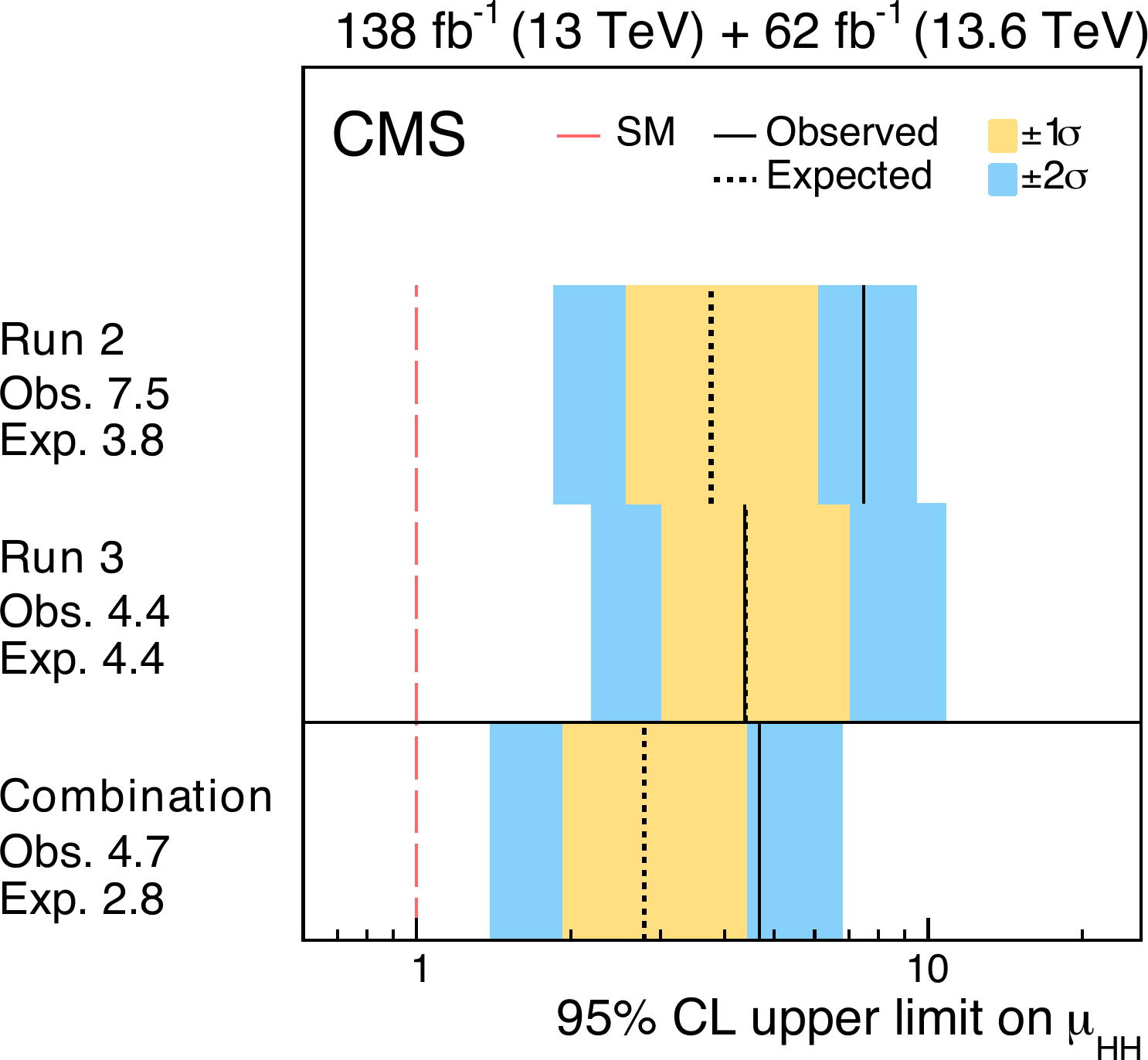
Measurements of Higgs boson pair ($\mathrm{HH}$) production in the four bottom quark (4b) final state are presented using proton-proton (pp) collision data at $\sqrt{s} = 13.6~\mathrm{TeV}$ collected by the CMS experiment at the CERN LHC, corresponding to an integrated luminosity of $62~\mathrm{fb}^{-1}$. Events in which the Higgs boson decays, $\mathrm{H \to b\bar{b}}$, are separately reconstructed as pairs of small-radius jets (resolved), as well as those where they are reconstructed as single large-radius jets (merged), are studied exclusively. Benefiting from new methods in trigger selection, event selection, and signal extraction, the combination of analyses in the resolved and merged topologies gives an observed (expected) upper limit on the $\mathrm{HH}$ signal strength, $\mu_{\mathrm{HH}}$, of 4.4 (4.4) at 95% confidence level (CL). Compared to previously published LHC results in the 4b final state, the expected limit with an equivalent integrated luminosity is improved by more than a factor of two in the resolved topology and is better in the merged topology as well. An updated analysis of the resolved topology using $138~\mathrm{fb}^{-1}$ of 13 TeV pp collision data yields an observed (expected) 95% CL upper limit on $\mu_{\mathrm{HH}}$ of 10.0 (5.9), an improvement of about 25% in the expected limit compared to the published results using the same data. Results in the 4b final state with 13 and 13.6 TeV are combined, resulting in an observed (expected) 95% CL upper limit on $\mu_{\mathrm{HH}}$ of 4.7 (2.8). The allowed ranges for the Higgs boson trilinear self-coupling and quartic coupling between two Higgs bosons and two vector bosons are also reported. These are the most stringent constraints achieved in the 4b final state to date.
Links
- Physical Review D
- arXiv:2604.27044
- CMS public results page
- Inspire HEP
- CERN Document Server
- Analysis code
Cite
@article{cmscollaboration2026improvedresultshiggsboson,
      title={Improved results on Higgs boson pair production in the 4b final state},
      author={CMS Collaboration},
      journal={Phys. Rev. D},
      year={2026},
      month={Sep},
      publisher={American Physical Society},
      doi={10.1103/w2zp-fckl},
      url={https://doi.org/10.1103/w2zp-fckl},
      eprint={2604.27044},
      archivePrefix={arXiv},
      primaryClass={hep-ex},
}